
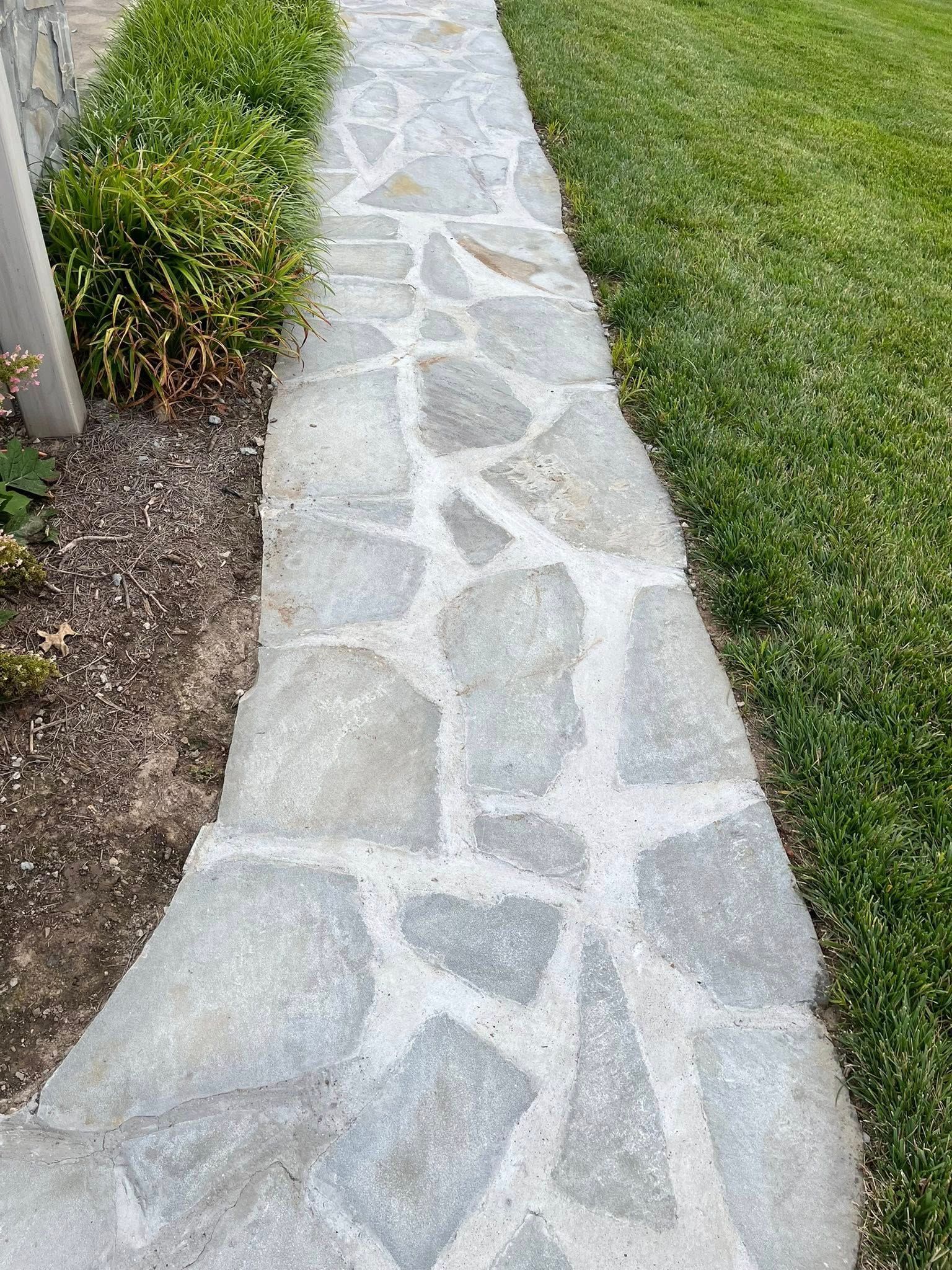
Connect Your Yard With Solid Footing
Walkways & Paver Paths in Greenville for properties where foot traffic creates mud tracks or uneven ground
Landscape Legends LLC installs walkways and paver paths across Greenville and surrounding areas for homeowners who need clear, stable routes between entry points, patios, driveways, and garden areas. You may already walk the same line through your yard repeatedly, wearing down the grass and creating a muddy trail every time it rains. A paver path gives you a surface that drains well, stays level, and handles foot traffic year-round without turning into a rut or puddle. It also defines the flow of your outdoor space and keeps dirt from being tracked onto porches, decks, or into the house.
This service includes site layout, excavation to proper depth, installation of a compacted gravel base, and placement of pavers in patterns that suit the style of your home and landscape. Edge restraint is installed to prevent the pavers from shifting outward, and joint sand is swept and compacted between each unit to lock everything in place. Materials range from concrete pavers in geometric shapes to natural stone with irregular edges, depending on whether you want a formal look or something that blends into wooded or informal settings. The result is a walkway that stays firm underfoot, sheds water to the sides, and requires minimal upkeep beyond occasional sweeping.
If you are ready to replace worn paths or connect different outdoor areas with a finished surface, reach out to discuss walkway design and installation in Greenville.
How Paver Paths Are Built to Last
You start with a marked path line that follows the natural flow of foot traffic or connects specific points like a front door to a driveway or a patio to a shed. Excavation removes sod and soil to a depth that allows room for base material and pavers, and the subgrade is graded to promote drainage away from structures. Crushed stone is spread in layers and compacted with a plate tamper to create a stable foundation that will not settle or shift when walked on repeatedly.
After installation, you will see a clean, bordered path that stays dry on top even after rain because water drains through the joints and into the stone base below. Pavers do not crack like poured concrete, and individual units can be lifted and reset if underground utility work or tree roots cause minor settling. Landscape Legends LLC matches paver style, color, and layout to the architecture of your home and the character of the surrounding landscape, whether that means a straight shot from curb to door or a curved path that winds through plantings.
Paths built without adequate base depth or edge support tend to spread, sink, or develop low spots that collect water. Proper installation accounts for frost movement, root growth, and the compaction behavior of local soils. This is not decorative surfacing; it is functional infrastructure that must handle weight, weather, and repeated use without breaking down.
What Homeowners Ask About Walkway Projects
Questions about materials, width, and timing come up often when planning a paver path in Greenville.
What width should a walkway be for everyday use?
A single-file path typically measures two to three feet wide, while a walkway meant for two people to walk side by side comfortably should be at least four feet across.
How do paver paths handle freeze and thaw cycles?
Pavers are designed to flex slightly and allow water to drain through joints, so they resist cracking better than solid concrete slabs that trap moisture and expand during Greenville winters.
When is the best time to install a paver walkway?
Spring and fall offer stable ground conditions and moderate temperatures, but installations can proceed year-round as long as the ground is not frozen or saturated.
Why do some paver paths develop dips or uneven sections?
Settling occurs when the base is not compacted thoroughly, when edge restraint is missing and pavers shift outward, or when soil underneath was not graded to shed water before base material was added.
What happens to existing landscaping along the path route?
Plants, mulch, and grass within the excavation zone are removed, and new edging or planting beds are typically added alongside the finished path to create clean borders.
If muddy trails or undefined routes are making your yard harder to use, contact Landscape Legends LLC to review paver options and plan a walkway that improves access and appearance across your property.